
Expert Insights

The Career Edit

Curated insights from industry leaders on navigating the modern job market

A mid-aged man in a red t-shirt, rendered in pop art style with bold black outlines and Ben-Day dot shading, straining in an arm-wrestling match against a sleek chrome robot arm across a white table, motion lines radiating from their locked hands, against a pure white background.
Career Advice

How to Future-Proof Your Career From AI

Most career advice about AI falls into one of two unhelpful categories: reassuring people that their job is safe, or warning them that everything is at risk and they need to learn to code immediately. Neither is particularly useful. The more honest framing comes from people who watched it happen to themselves first. In a widely-read piece in Fortune, Matt Shumer, who has spent six years building AI companies, described the experience directly: the AI work he'd been doing wasn't automating peripheral tasks anymore. It was doing his core technical work, end to end, better than he could do it himself. He wasn't predicting this. He was reporting it. The question his piece prompted for a lot of people wasn't "is AI coming?" It was the more uncomfortable one: do I actually know which parts of my own work are vulnerable, and do I know myself clearly enough to find out?

A mid-aged man in a gray suit, rendered in pop art style with bold black outlines and Ben-Day dot shading, casually tossing a crumpled white resume over his shoulder with a bored expression, against a pure white background.
Resume

Why Your Resume Is Getting Rejected (It's Not ATS)

If you've spent hours optimizing your resume for ATS, adjusting keywords, fixing formatting, running it through scoring tools and you're still hearing nothing back, here is a truth I have for you: ATS probably isn't the problem. A former recruiter who spent years on the other side of the process, reviewing hundreds of resumes a week explains what's actually happening, and it has nothing to do with parsing algorithms.

A mid-aged man in a yellow sweater, rendered in pop art style with bold black outlines and Ben-Day dot shading, leaning back in a chair with hands behind his head and a wide joyful smile while looking at a laptop screen, against a pure white background.
Job Search Tips

Job Hunting Tips That Work in 2026

The job market right now is genuinely hard. Roles are filling faster, competition is wider, and entire categories of work are shrinking as companies automate what they used to hire for. If you're in customer support, junior ops, basic admin, or any role that AI can now approximate, you're not imagining it, you're competing against more people for fewer openings than you were two years ago. The honest question to ask yourself isn't "why isn't this working?" It's: are you strong enough on paper and in person to win in a market where every role has 300 applicants within six hours of posting? If the answer is yes, you're probably already getting traction. If it isn't, here's what actually moves the needle.

A young man in a navy blazer, rendered in pop art style with bold black outlines and Ben-Day dot shading, studying a laptop screen displaying an abstract resume layout with bullet points and section dividers, against a pure white background.
Job Search Tips

How to Write Resume Bullet Points That Get You Noticed

Most resumes describe a job. The ones that get callbacks describe a person. The difference almost always comes down to how bullet points are written, and it's a fixable problem that doesn't require a new job, new skills, or anything you haven't already done. One of our professional resume writers who has worked through hundreds of resumes breaks down exactly what's going wrong and how to rewrite it, including if your role never had a single metric attached to it.

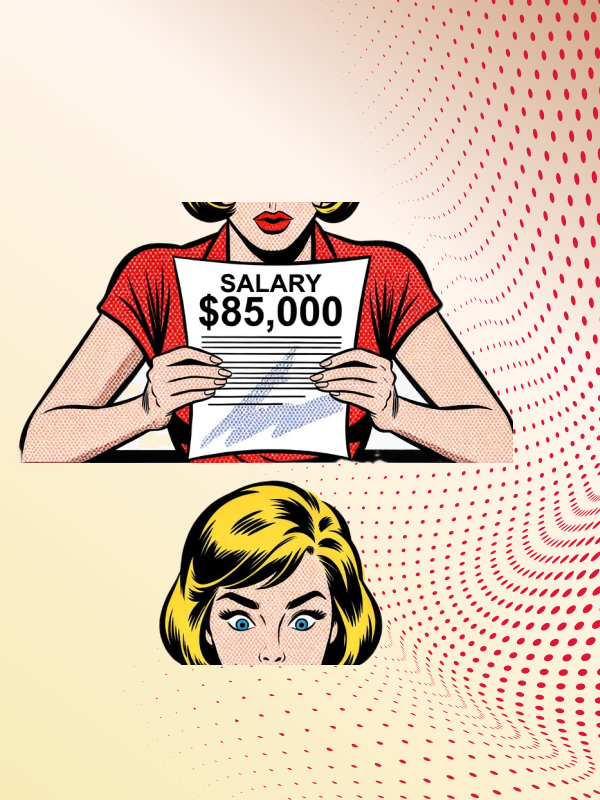
A mid-aged woman in a red blouse, rendered in pop art style with bold black outlines and Ben-Day dot shading, holding a white job offer letter with an expression of hopeful surprise, against a pure white background
Job Search Tips

How to Negotiate Salary (And Stop Leaving Money Behind)

Most salary negotiations are lost before they begin, not at the offer stage, but the moment a recruiter asks "what salary range are you expecting?" and you answer too quickly with a number that sounds reasonable instead of the number you actually want. It's one of the most expensive mistakes in a job search, and it happens in seconds. Here's what actually goes on during that question, why your instinct to answer fast works against you, and exactly what to say instead.

A young man in a yellow t-shirt, rendered in bold pop art style with black outlines and Ben-Day dot shading, gripping his head with both hands in an expression of vivid frustration, against a pure white background.
Job Search Tips

Job Search Tips That Actually Work (97 Interviews Later)

Somewhere around interview 50, most people would have stopped counting. This person kept going - through 97 interviews, 40-plus companies, four intense take-home projects, and one cross-country flight before finally landing an offer. That's not a failure story. It's one of the most useful datasets a job seeker can read, because it comes from someone who iterated in real time, figured out what moved the needle, and can tell you exactly what changed. If your search has stalled and you're not sure what to adjust, start here.

A mid-aged woman in a blue blouse, rendered in pop art style with bold black outlines and Ben-Day dot shading, intently reading a smartphone held close to her face, against a pure white background.
Job Search Tips

How to Research a Company Before an Interview (The Right Way)

Most candidates preparing for an interview do the same thing: read the company's About page, skim the LinkedIn profile, maybe check the overall Glassdoor rating. It feels thorough but it mostly isn't. The most useful information about what it's actually like to work somewhere isn't in the polished content a company publishes about itself. It's in what people say when they leave. Here's a company research method that most job seekers never think to use, and why it's one of the highest-signal things you can do before walking into an interview.

A pop art–style desktop computer setup on a white surface, featuring a flat-screen monitor, compact tower, and keyboard, rendered in bold red, blue, and yellow with thick black outlines and Ben-Day dot texture, against a pure white background.
Job Search Tips

How ATS Systems Actually Work (Most Advice Is Wrong)

You're sending out application after application. Not even rejections are coming back, just silence. Your experience is solid, your resume looks clean, and you can't figure out what's broken. Here's what's likely happening: your resume is getting filtered out by an Applicant Tracking System before a human ever sees it. And the advice most people follow to fix that (mostly keyword stuffing, fancy formatting, creative section headers) is just outdated. Here's what ATS systems actually do.

Vintage photo of a confident woman being interviewed for a job with a male manager seated at a wooden desk in a 1950s office.
Job Search Tips

Best Question to Ask at the End of Every Interview

You're getting interviews. You're preparing well, answering questions clearly, and walking out feeling like it went fine. Then you wait. And wait. And the offer doesn't come. If that sounds familiar, the problem probably isn't your answers, it's your close. Most candidates end interviews the same forgettable way, and the question you ask last is one of the most underused tools you have. One specific closing question can change your offer rate, and almost nobody is using it.

Previous
12
Next

Your Career Awaits

Ready to Take Action?

Transform insights into opportunities. Let our experts handle your applications while you focus on what matters.